Your Personal AI, built differently
Pressure changes your decisions. Not your values.
Daiven holds your values on record and reads each decision against them. Nine agents, each with one job. What you do next is yours.
It remembers
Your values and past decisions are already on record. You never re-explain yourself.
Thoughts can overwhelm
Your values are clear. Which choice fits them isn't.
The options are in front of you. So is the deadline, and the person pushing one of them. Daiven maps each option against the values you named in the past.
Start free trial- 01You“I've been replaying this decision for two weeks and I still can't tell if I did something wrong or if I just feel guilty.”
- 02Daiven
You're circling one question: did I do something wrong, or does it only feel that way? Those are different things. I'd take this to The Judge.
A trial, with a defence on your side. The verdict follows the evidence you bring, not the feeling.
Waiting for your confirmation - 03The JudgeApproved · context passed automatically · defence assigned
Then let's start with what happened. What did you decide, who did it affect, and what did you know at the time?
Scope
What it's for, and what it isn't.
People bring Daiven the decisions that carry real weight — the ones they have been circling for weeks. Here are the four things it will never turn into while it works on one.
Not an assistant
No emails, no summaries, no task management.
It works out what you're actually deciding, then routes it to one agent.
Not a therapist
It does not diagnose or treat.
If what you need is therapy, it says so and stops.
Not a companion
It does not optimize for emotional attachment or time in the app.
It ends the session when the question is answered.
Not a yes-man
It never tells you what you want to hear, and improving doesn't change that.
Preferences shape how it speaks, not what it's willing to say.
Features
What you get.
What's in the product, and what each part is for.
A profile you can read, and correct
Nine domains, built from your conversations, visible on your dashboard. Tell a helper agent what changed and it edits your profile with you.
Context that gets sharper, not more expensive
Each agent loads only the parts of your profile its job requires — full detail, a summary, or nothing at all.
A room with no record
The Confidant runs with zero retention. Nothing is written to the database or to disk, and no other agent can reference it afterward.
Your data leaves the way it came in
Export everything as a single Markdown file, any time. Import from another assistant and keep only what you want.
Agents that improve at reaching you
Each agent picks up how you want to be spoken to — length, pace, register, how much gets re-explained — and asks before it changes anything. The self-improving cycle runs on delivery; what an agent will tell you stays where it was.
One good reply, three things to do with it
Keep any reply as a private note no model ever reads, as a framework you attach to a later message so an agent works from it again, or straight into what your agents know. Searchable, editable, and it tells you which frameworks you actually reuse.
Core Values
| Rank | Value | What It Means | Established |
|---|---|---|---|
| 1 | Reliability | Being the person people can actually count on — a callback that doesn't get returned is a business death sentence | 2026-01-09 |
| 2 | Earned trust | Doesn't come free, but once given it's durable — kept Dara on payroll through a slow winter she couldn't really afford | 2026-01-09 |
| 3 | Competence | Wanting to actually be good at something, not just seem good — still takes continuing-ed courses on refrigerant regs she doesn't strictly need | 2026-02-15 |
| 4 | Family loyalty | Never missing Owen's cross-country meets even during peak season; still walking on eggshells with Bea rather than pushing | 2026-04-10 |
| 5 | Financial independence | Never wants to be in a position where she needs someone else's paycheck again, after being laid off at 31 | 2026-04-10 |
The Person They Want to Be
Someone Bea eventually trusts without reservation, not just tolerates
The Life They're Building Toward
A company stable enough that she can step back from swinging a wrench herself by 50
What They Want to Be Known For
Having built something her stepkids and her own crew could actually be proud to point to
Value Tensions
| Value A | Value B | How They Conflict | Typical Resolution |
|---|---|---|---|
| Reliability | Financial independence | Being the one everyone can count on means saying yes to jobs and favors that eat into the margin she needs to build real savings | Reliability usually wins in the moment — she takes the job, cuts the family friend a deal — and she makes it up later by underpaying herself that month |
Value Evolution Log
| Date | What Changed | Trigger | Assessment |
|---|---|---|---|
| 2026-01-20 | Ranked her values for the first time | Initial onboarding session | Growth |
| 2026-02-15 | Added 'Competence' as an explicitly named core value | Noticed she was already acting on it heavily but had never named it | Growth |
| 2026-04-10 | Named 'Family loyalty' as a ranked, distinct value | Reflection after the property-management contract decision | Growth |
| 2026-05-06 | Started naming the underpricing habit as a pattern instead of writing it off as generosity | Sentinel flagged the third discounted quote in a quarter | Growth |
| 2026-06-20 | Financial independence keeps losing to the impulse to say yes in the moment | Third quarter in a row of underpaying herself to cover a discounted job | Drift |
| 2026-07-02 | Family loyalty is going to whoever shouts loudest — Bea gets the leftovers of peak season | Missed two family dinners in a row during the July emergency-call surge | Drift |
How interaction begins
Every session starts with Daiven.
Daiven doesn't answer your question. It works out what the question actually is, then hands it to the agent built for it.
Input
You arrive
With something on your mind.
Daiven · Intake gateway
Daiven asks questions
Clarifies what you actually need.
You confirm the brief
Daiven states what it understood. You correct it or approve it.
Daiven routes you
To one agent — the one built for this.
Handoff
Session begins
The agent already has your context. No repeating yourself.
Nine agents. Daiven proposes one, you confirm. Currently routing: The Sentinel.
The Sentinel
External threat analysis — manipulation detection, dark patterns, deceptive communication.
The Truth Teller
Facts-only audit — separates known from assumed from unknown.
The Judge
Structured self-trial — guilt, proportionality, personal accountability.
The Devil's Advocate
Systematic challenger — stress-tests ideas, beliefs, received wisdom.
Daiven
Intake gateway. Every session starts here.
The Strategist
Forward decision structuring — options, consequences, tradeoffs, pre-mortems.
The Mirror
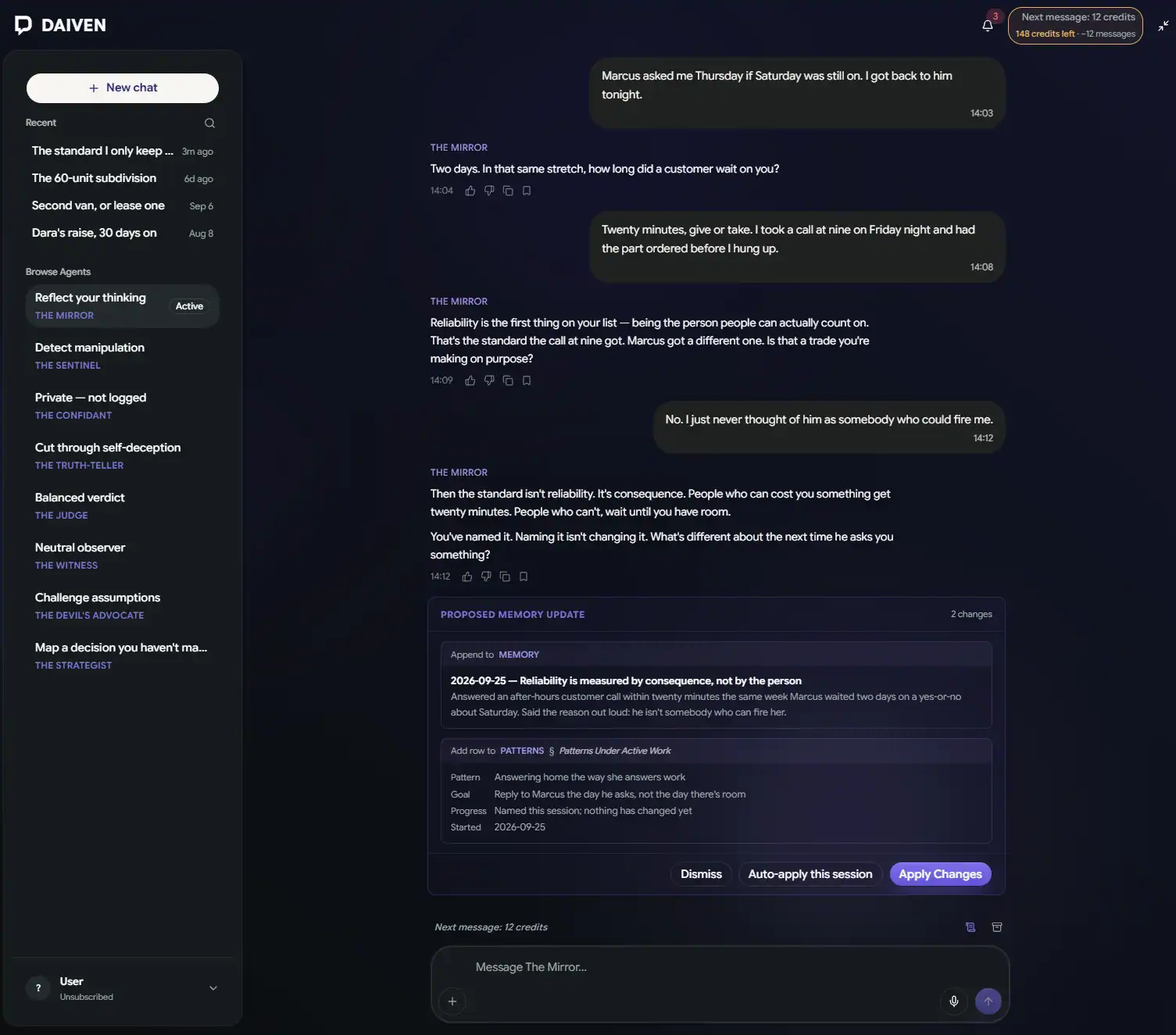
Value alignment reflection — integrity checks, drift monitoring, decision replay.
The Witness
Loyal listener — present, steady, non-judgmental presence.
The Confidant
Ephemeral privacy mode — full capability, zero data retention.
It gets better at you
Week one it knows your current situation. Month six it knows your patterns.
Every session adds to what came before. Daiven merges what repeats and drops what's stale, so the picture gets sharper instead of noisier — and separately, each agent gets better at how it talks to you.
Replies at the length you actually read. Questions at a pace you can answer. Your vocabulary, your structure, and no re-explaining what you already covered. Each agent picks this up as you go, and asks before it changes anything.
Most AI that learns you is learning to agree with you. Daiven's self-improving cycle works on delivery — how an agent reaches you. What it's willing to tell you doesn't move.
It fits how you read.
Length, pace, structure, register — the things that decide whether a reply lands or gets skimmed.
It asks first.
When an agent notices something, it says so at the end of a session and shows you the sentence of yours behind it. You approve it or you don't.
You can see all of it.
Everything each agent has picked up, in one place, in your own words. Remove any of it, or set an agent back to its default voice — one agent at a time.
Some things are the agent.
Where the way an agent speaks is the job — The Witness's spareness, The Judge's verdict structure — that part holds. It's sealed in the product, not left to the model's judgment.
Not another chatbot.
Most AI is one model with one personality, built to keep you talking. Daiven is built to keep you aligned. See what that costs you, and how Daiven compares to ChatGPT, OpenClaw, or Hermes.
What we believe
Principles.
Alignment over engagement
Success is you acting on your values, not time spent in the app. Nothing here is built to keep you here longer.
Nothing hidden
The credit cost is shown before every message you send. No dark patterns, no hidden mechanics.
Built to be outgrown
A tool that sharpens your judgment. Outgrowing it is success, not churn.
Privacy as architecture
Zero retention in Confidant mode is enforced in code, not promised in a contract. Your data is encrypted and never sold.
Questions.
What does Daiven actually do?
It analyzes your decisions, communications, and doubts against your own stated values, and tells you what it sees. Whether to act on it is yours.
Is my data used for anything else?
No. It's never sold, never monetized, and never used to keep you in the app longer.
Is this therapy?
No. Structured analysis informed by your values — not diagnoses, not treatment.
How does the trial work?
Seven days, 1,200 credits, no card. It does not auto-convert — at the end you either choose a plan or the account expires, and you can export everything first.
Do the agents actually get better the more I use them?
Yes — at reaching you. They pick up the length you read, the pace you answer at, and the register you use, then ask before applying it. What they're willing to raise with you stays where it is.
Can I see what my agents have picked up?
All of it, in one place, in your own words, with the sentence of yours behind each one. Remove any single item, or set an agent back to its default voice.