AI
What Is an AI Agent? Meaning, Skills, and Limits
On this page
- 1.What is an AI agent?
- 2.How is an AI agent different from a chatbot?
- 3.AI agent terms in plain language
- 4.What are agent skills?
- 5.What goes wrong when an agent acts on a guess?
- 6.What is an AI agent platform?
- 7.How Daiven's agents work
- 8.How to judge an AI agent before you trust it
- 9.The part that does not get better on its own
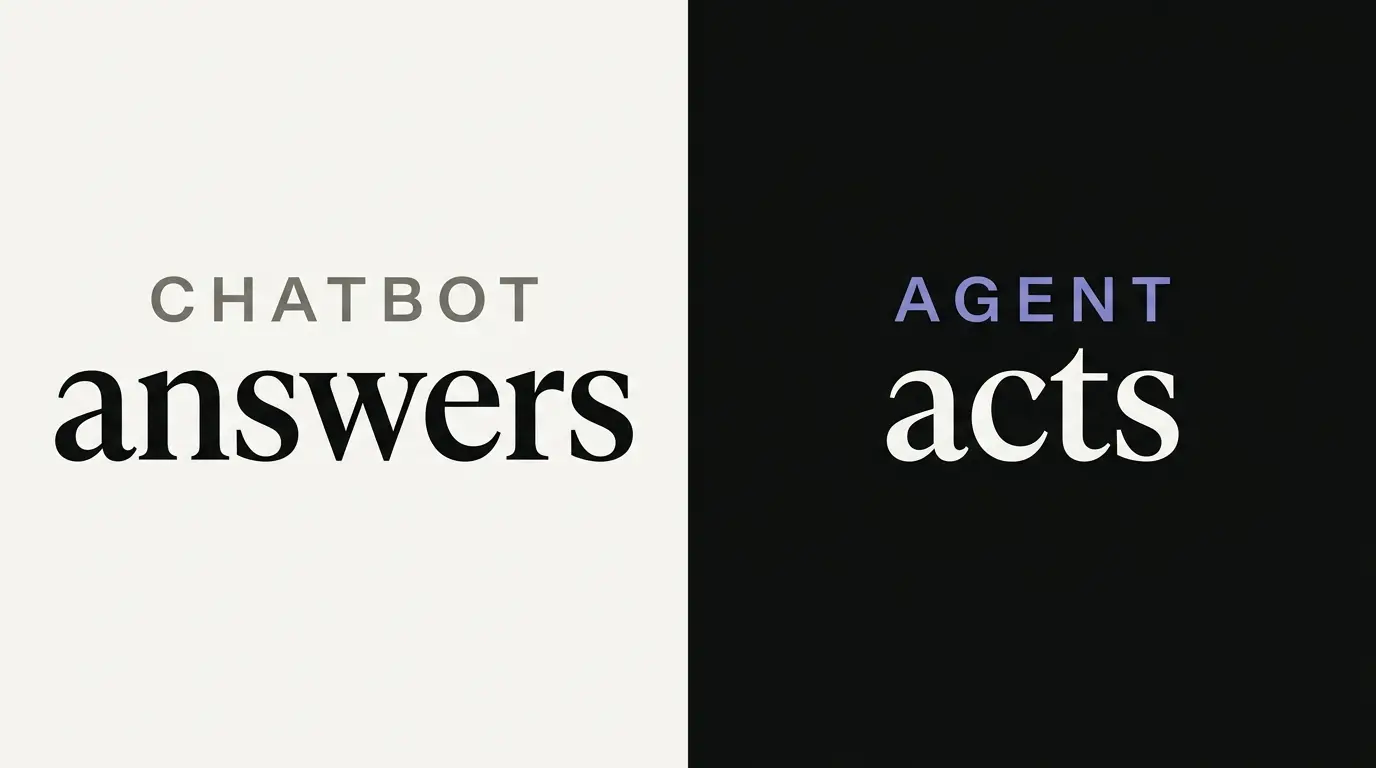
Ask a chatbot to cancel a subscription and you get a well-written email to send yourself. Ask an AI agent to do it, and the subscription is canceled.
That is the whole difference, and it is smaller than it sounds. An AI agent is a language model that has been given a goal, a set of things it is allowed to do, and permission to keep going until the goal is met — without checking back with you at every step. Same underlying model as the chatbot. Different leash.
So the useful question is not what an agent can do. Everything in this category can do a lot, and the list gets longer every month. The question is what it does without asking you first.
What is an AI agent?
An AI agent is an AI system that pursues a goal on your behalf. It reads a situation, decides what to do next, takes an action using tools it has access to, checks the result, and repeats until the job is finished or it gets stuck. A chatbot produces text. An agent produces changes.
Four things turn a model into an agent:
- A goal. Something to be completed, not a question to be answered.
- Tools. The things it can actually reach — a web search, your calendar, a payment system, a folder of your files.
- Memory. What it carries between steps, and between sessions.
- A loop. The ability to act, look at what happened, and decide the next move on its own.
Take the loop away and you have a chatbot with plugins. Take the tools away and you have a chatbot with ambition.
The word itself is older than the current wave of AI. In computer science, an agent is just a program that observes its environment and acts on it — nothing in the term implies intelligence, autonomy, or judgment. It implies action. That is worth remembering when a product page uses "agent" as if it were a promise about quality.
How is an AI agent different from a chatbot?
A chatbot hands you work. An agent does the work. Everything else follows from that, including the part most explanations leave out: where a misunderstanding surfaces, and whether you get to catch it.
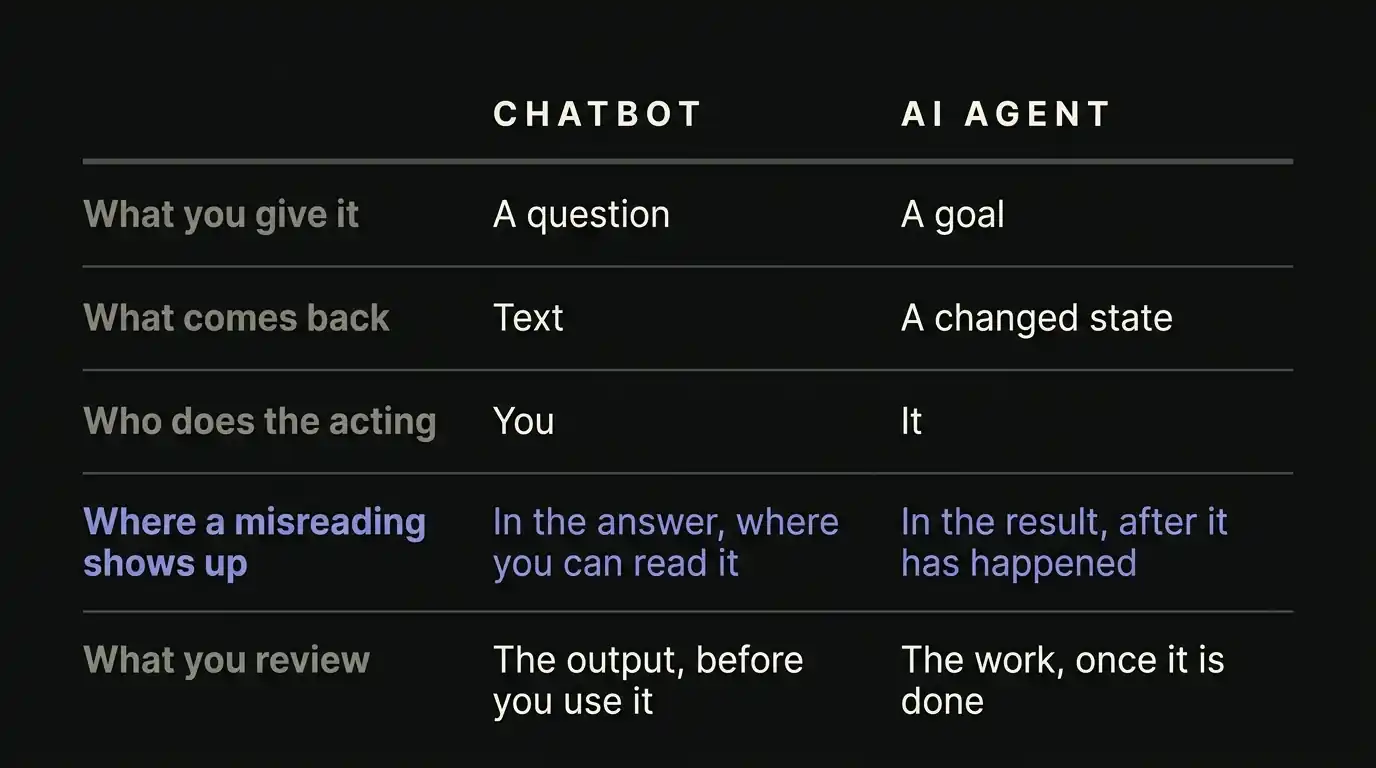
The fourth row is the one worth sitting with. When a chatbot misreads you, you skim a paragraph that is subtly about someone else, and you rephrase. Ten seconds. When an agent misreads you, the first evidence is the outcome.
This is not a warning about rogue software. It is a plain description of what changes when you move the acting from your side of the screen to the model's side. Autonomy does not make a system smarter. It makes whatever it already understood arrive faster.
AI agent terms in plain language
Most of the vocabulary around agents describes the same handful of ideas in a way that makes them sound larger.
| Term | What it means |
|---|---|
| AI agent | A model given a goal, tools, and permission to act until the goal is met. |
| Agentic | An adjective for software that acts rather than answers. An "agentic workflow" is a task broken into steps the model runs itself. |
| Agent skill | A packaged capability you add to an agent: instructions for a kind of task, plus the actions it may take to do it. |
| Tool | One thing an agent can do. Run a search, add a calendar entry, edit a file, make a payment. |
| Autonomy | How far it gets before it needs you. This is a setting, not a property. |
| Orchestration | Deciding which agent or which step handles what. Also called routing. |
| Multi-agent system | Several narrow agents rather than one general one, with something deciding between them. |
What are agent skills?
An agent skill is a capability you hand to an agent — a set of instructions for a particular kind of work, bundled with the tools needed to carry it out. Skills are how one general agent becomes useful for something specific, like bookkeeping or inbox triage, without anyone retraining a model.
In practice they look different depending on where the agent runs. On self-hosted platforms, a skill is usually a folder of files you install, read, and maintain yourself. On hosted products, skills are whatever the vendor has built and switched on for you. Either way, the effect is the same: the answer to "what can this agent do" is not fixed, and it changes every time someone adds one.
Here is the part that gets lost. A skill is permission as much as capability. Installing one does not only teach an agent to do something new — it decides what the agent may do while you are not watching. Those are the same act, described from two directions, and only one of them usually appears in the marketing.
What goes wrong when an agent acts on a guess?
Language models do not say "I do not have enough information." They fill the gap with the most probable reading and carry on. In a chat window that produces an answer aimed at the wrong person. In an agent, it produces work.
You are buying a birthday present for your sister. She has mentioned wanting to start hiking properly, so you ask:
You: Which waterproof hiking boots are worth buying?
Assistant: Since you're doing more winter hill walking this year, I'd stay with a stiff sole and a full leather upper…
Nothing there is a malfunction. There was a gap in your question — who the boots are for — and the model filled it from the most relevant thing it knew about you, which was a walking trip you mentioned seven months ago. Then it wrote the guess into the answer as though you had confirmed it. You now have boots chosen for an experienced winter walker, on their way to someone who has never owned a pair.
This is also why the standard advice makes things worse rather than better. Everyone tells you to give the model more context: let it remember you properly and the guessing will stop. It does not stop. It gets promoted. An assumption drawn from something genuinely true about you arrives with a reason attached, which makes it harder for you to notice and easier for the model to commit to. The stale detail is the dangerous one, because it is real.
In a chat window this costs you a few seconds and a second attempt at the question. Give the same behavior a calendar and a card on file, and the wrong assumption stops producing paragraphs. It produces a purchase.
Which leaves one place to intervene, and it is earlier than most products put it: before any work begins, get the goal right.
What is an AI agent platform?
An AI agent platform is where an agent runs and what it is wired into — the models behind it, the tools it can reach, the memory it keeps, and the rules about what it may do unsupervised. As of 2026 they come in three shapes, and the differences between them are mostly about who carries the risk.
General assistants with agent features. ChatGPT and its equivalents. You sign up, nothing gets installed, and the range is enormous because the product refuses to specialize. The provider keeps the lights on. What it does with an ambiguous request is pick the likeliest reading and proceed.
Self-hosted autonomous agents. OpenClaw and Hermes are the ones people mean. You run them on your own hardware with your own API keys, which buys real control — and hands you the machine, the uptime, the updates, the backups, and every security decision. That last one is not theoretical: security firm Bitsight found more than 30,000 exposed instances reachable online in research conducted between late January and early February 2026. Running costs land on you too, and they are not always visible up front — one open issue on Hermes documents roughly 73% of every API call being fixed overhead before your actual question is processed.
Narrow hosted agents. Built for one job and nothing else. Daiven is one of these. The trade is straightforward: it will not do most of what the other two do, and there is nothing for you to maintain.
We keep a sourced comparison of all three against Daiven — setup, memory, data handling, who fixes it when it breaks — on the product page.
How Daiven's agents work
Daiven is nine agents, each built for one job, and one of them decides which one you need. Nothing starts until you have confirmed what it understood you to be asking.
Every session begins in the same place. You arrive with whatever you arrived with — "this email feels off," "I need to think about this job offer" — and Daiven asks only the questions that close a gap. Then it states back what it understood. You correct it or you approve it, and the agent that picks up the work starts from that, not from what you typed.
That step is the whole design. It exists because the failure described three sections up is not rare or exotic. It is the normal behavior of every model when a request is thinner than the task, and the only reliable fix is to resolve the ambiguity while it is still cheap.
The agents themselves are narrow on purpose. One reads a message you were sent and tells you what it is doing. One separates what you know from what you assumed. One maps a decision that is still open, including the version where a year has passed and it was clearly the wrong call. One holds your stated values up against the last six weeks of your calendar. One writes nothing anywhere, so the session leaves no record. You can read what each is for, and what each will not do, on the agents page.
Two limits are worth stating here rather than making you find them. Daiven has no integrations — it does not touch your inbox, your calendar, or your tasks, and it does not automate anything. If that is what you want from an agent, OpenClaw is better at it and it is not close. And it cannot be self-hosted; your profile lives in our database, encrypted with a key that is yours.
If the nine do not cover your particular subject — your business, your money, one situation that keeps coming back — you can build one of your own. Nine, plus one you build. You define its job and which parts of your profile it is allowed to read. It is a top-tier feature, one per user.
How to judge an AI agent before you trust it
None of this requires you to know how any of it works. Five questions do most of the job, and they apply to any agent, including ours.
- What can it do without asking me? Get this in concrete terms — which tools, which accounts, which actions. "It's fully autonomous" is a feature claim, not an answer.
- What does it remember, and can I read it? If you cannot open what it believes about you, you cannot correct it, and every future action inherits the error.
- When it misreads me, do I find out before or after? A product that resolves ambiguity by asking is making a different bet than one that resolves it by guessing well. Both are defensible. Only one of them shows you the guess.
- Who fixes it when it breaks, and who is responsible when it acts wrong? On self-hosted platforms both answers are you. That is a fair trade if you know you are making it.
- Can I get my data out? Ask what the export actually is. A file another tool can read is a different thing from an archive you have to unpack.
The part that does not get better on its own
Agent capability is going to keep climbing. That is the safest prediction in the industry and the least interesting thing about it.
What separates a useful agent from an expensive one is narrower and duller than capability: whether the thing it set out to do was the thing you asked for. Everything downstream of that is amplification. A misread goal executed flawlessly is still a misread goal, delivered sooner and with more of your accounts involved.
The measure of an agent is not what it can do without you. It is whether it understood you before it started.
See the nine agents, or read how Daiven compares to the alternatives.

Written by
Przemek Czerpiński
Founder & Developer
Przemek Czerpiński founded Daiven and built it himself. He's been building LLM products since 2024 — most recently multi-agent systems designed to adapt to people without flattering them. He studies AI behavior directly, testing it extensively in the roles people hand it: assistant, therapist, companion, advisor. Before that he spent over a decade in consumer products, where engagement was the metric. That's what Daiven is built against. More about him and about Daiven.
Now check it against your own decisions.
Daiven measures what you do against the values, principles, and goals you've already written down — not the tone of your last message.
Start free trial