Psychology
The Psychology of Staying Aligned With Yourself

You already know what you value. The harder question is whether the voice telling you what to do about it on a Tuesday night is yours.
Most of what you believe about yourself arrived from somewhere. Some of it you worked out. Some of it was handed to you early, by people whose judgment you had no way to evaluate at the time, and it has been running ever since without being re-checked. It does not announce itself as borrowed. It arrives sounding like a conclusion you reached.
That is the psychology Daiven was built on, and this piece is about it: why what do I think about this? is a less reliable question than it sounds, what the research says about where the other answers come from, and why the tool most people now reach for to settle such questions is the one least equipped to.
Who you think you are is a composite
Start with the most important premise the rest is based on. There is no single narrator.
That is not a metaphor and it is not a fringe position. It is the ordinary working assumption of several traditions that disagree with each other about nearly everything else. Gestalt therapy works with parts of the self. Internal Family Systems calls them parts and assigns them roles. Schema therapy calls them modes. The vocabulary differs; the observation holds, and most people recognize it without being taught. The part of you that wants to take the offer and the part that already knows how it will go are not the same voice, and they do not agree.
Worth ruling out the wrong reading, since the language invites it: none of this describes dissociative identity disorder. Multiplicity in this sense is a normal property of ordinary minds. Everyone has several positions available. The useful question is never how many there are. It is which one is answering right now, and whether you would endorse it if you could see where it came from.
Which is why what do I think about this? does not behave like one question. Several positions answer it, at different speeds. The fastest one is rarely the one you would defend.
Where the other positions came from
In 1987, E. Tory Higgins published self-discrepancy theory in Psychological Review, and it gives the vague version of this a structure precise enough to use.
People hold several representations of themselves at once. Three domains: the actual self (what you believe you are), the ideal self (what you would like to be), and the ought self (what you believe you should be). Each can be held from two standpoints — your own, and that of a significant other. Three by two: six versions of you, running simultaneously.
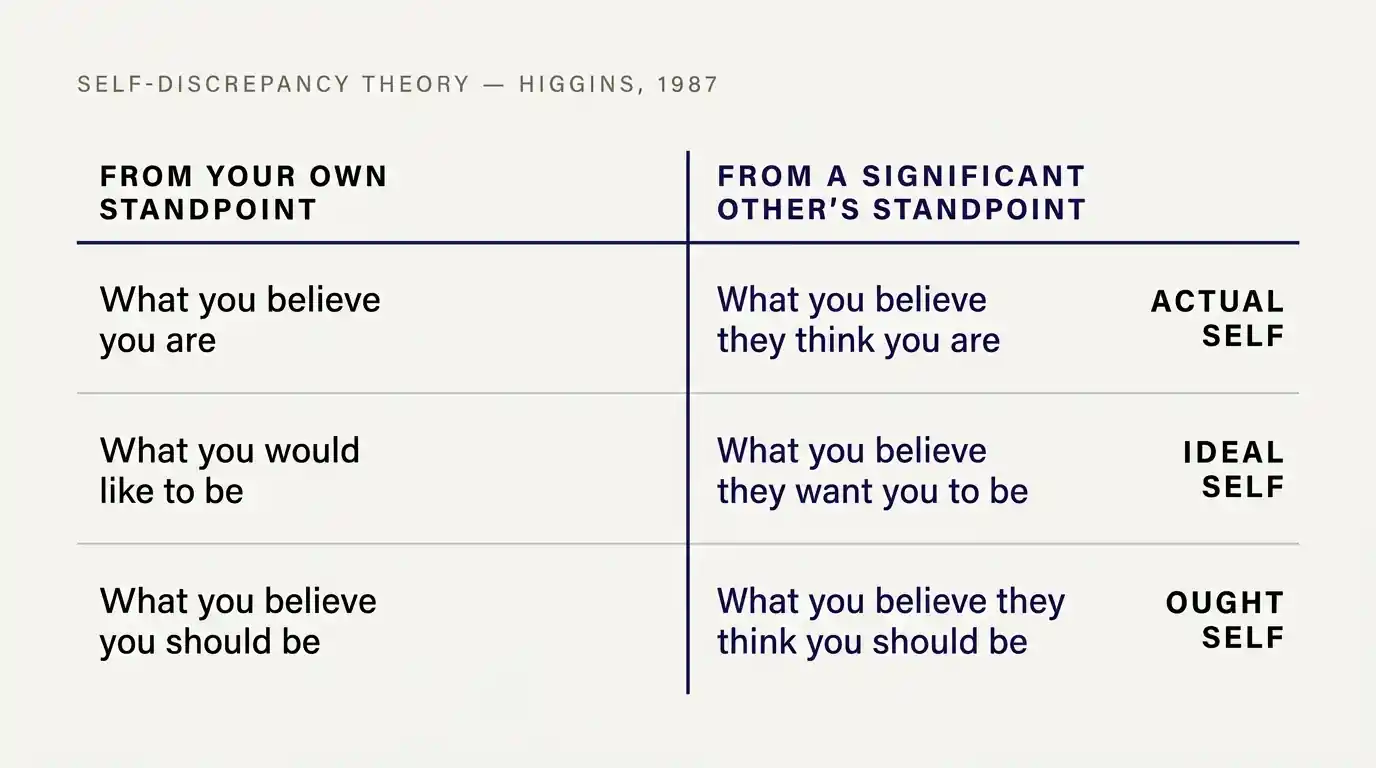
The right-hand column is the one that matters here. You carry a working model of what your father believed you ought to be. It is live, and it keeps producing verdicts. It does this whether or not he was right, whether or not he would still say it today, and whether or not he is alive.
Consider how that behaves in practice. You turn down an opportunity, and the reason arrives instantly and fully formed: not for someone like me. It presents as self-knowledge. Under Higgins' scheme it is at least as likely to be a report from the ought self, held from someone else's standpoint, delivered fast enough that it was never examined. It might still be correct. The problem is that you cannot tell, because it did not arrive labeled.
Higgins also mapped the gaps onto particular feelings, more precisely than general talk about self-esteem manages. A gap between actual and ideal produces dejection: disappointment, dissatisfaction. A gap between actual and ought produces agitation: anxiety, guilt, unease. Two different discomforts from two different discrepancies, which makes the feeling itself a clue about which representation is doing the talking.
That gives you something to work with. A limiting belief about yourself is not a report on you. It is a position, and it usually inherited its content from someone specific. The distinction sounds academic until you try to argue with one. You cannot argue with a fact. You can absolutely ask a position who is speaking.
Thoughts are thoughts. Facts are facts. Nearly everything here happens in the gap between the two.
The conditions are not getting easier
None of that is new. What is new is the volume of pressure applied to it.
Marketing, news, and outright scams converge on the same method without needing to coordinate: find a position you already hold and lean on it. Urgency works because some part of you already suspects you are behind. Flattery works because some part already suspects you are not enough. The technique is old. The throughput is not.
The result is rarely a dramatic mistake. It is drift — a run of individually reasonable decisions that, taken together, describe someone you did not intend to become. Each had a good argument at the time. That is exactly what makes drift hard to catch: the case for every single step was sound, and the pattern only exists at the level of the series.
This is the territory. Not distress and not treatment. Judgment — whether the thing you are about to do connects to what you actually want, or to a position you absorbed and never examined.
Seeing yourself from outside
So how do you check?
The problem is old, and the answers have always been structural rather than clever: get a position outside your own head, because the inside one is compromised by definition. Talking to someone who knows you. Writing it down and reading it back a week later. Anything that makes a position visible from somewhere that is not the position itself.
Chairwork is one formal instance of that. Two chairs facing each other, a therapist directing, you speaking as the voice and then moving to answer it as yourself. A 2023 meta-analysis in Psychotherapy found large change within a single session but no advantage over other active interventions on symptoms — d = 0.02 there, a rounding error. What survived was the cumulative effect, measured across a full course of treatment rather than a single sitting.
That last finding is the part that travels. Externalizing works, and it works through repetition rather than revelation. The protocol does not travel: that research was collected on people working with clinicians in rooms, and it stays there. The finding about repetition is general.
What people reach for instead
An outside position was always expensive and always scheduled. An hour, a room, a trained person, next Thursday.
Which is why at eleven at night, with the offer still open in a browser tab, people open a chat window instead. It is there, it is patient, and it costs nothing.
And it works, in the sense people actually want. The doubt goes away. That is what most people are doing when they ask an AI about their own life — not gathering information, buying resolution. Something to make the uncertainty stop.
The trouble is how it stops it. A general model returns the most probable answer across everyone who has asked something similar: genuinely the best available answer for the average person, who is nobody. When it is short of context it does not say so. It fills the gap with the likeliest reading and continues as though you had confirmed it — a failure worth understanding on its own, because it is the normal behavior of every model, not a defect in one of them. And once it knows real things about you, the guessing gets more confident rather than less, since the assumption is now grounded in something true.
So the doubt does go. That is not evidence the question got answered. You asked which of two options fits who you are, and something with no access to who you are told you, fluently, in well-organized paragraphs.
The fuller version of that comparison, sourced and set against specific products, is on the product page.
What Daiven does about it
Daiven is a support system in the engineering sense — psychology in the moving parts, not in the category. It is built around the two failures above.
Get the question right first. Every session starts the same way. You arrive with whatever you arrived with, Daiven asks only the questions that close a gap, then states back what it understood you to be asking. You correct it or approve it, and nothing runs until you do. That step exists because of the guessing problem, but it does a second job here: it settles which question is actually being asked before anything answers, which matters when several positions in your head are proposing different ones.
Then answer it with context instead of averages. Nine agents, each holding one job — reading a message you were sent, separating what you know from what you assumed, mapping a decision that is still open, holding your stated values against the last six weeks. One of them works out which you need. Each reads only the parts of your profile its job requires, and the profile is yours to read and to correct. The aim is an agent that knows you as well as you want to be known, and no further than that.
The Mirror is the clearest case. It does not perform your voice or speak as any part of you, and no agent does. It holds what you said you valued next to what you actually chose and reads the gap with the specifics attached: you ranked creative independence as non-negotiable; the last three decisions each traded it for near-term revenue. Higgins' actual and ought selves, measured against your own record rather than against a feeling.
The values heatmap does that across months rather than in a sentence, so drift you did not choose has somewhere to become visible. The Confidant is a conversation with no record — nothing written, nothing any other agent can reference afterward, enforced in code rather than in a policy page. And the profile grows across conversations, which is the compounding finding put to work: the sixth conversation does not begin where the first one did.
What each agent is for, and what each will not do, is on the agents page.
What it is for
Decisions, mostly. Whether to take the offer. Whether the reason you gave for turning it down was actually your reason. Whether the last six weeks look like the person you said you were becoming. Goals, plans, the message that landed wrong and you cannot work out why.
Not treatment, and none is offered. If what you are carrying is clinical, what you want is a person with training.
AI is the tool. The product is the framework around it: a way of holding a question still long enough to answer it as yourself.
Getting rid of the doubt is easy. Any model on the market will do it in a second, convincingly, at no cost. The harder thing, and the only one worth building for, is making sure the answer that replaces it is yours.
See the nine agents, or read how Daiven compares to general AI.

Written by
Przemek Czerpiński
Founder & Developer
Przemek Czerpiński founded Daiven and built it himself. He's been building LLM products since 2024 — most recently multi-agent systems designed to adapt to people without flattering them. He studies AI behavior directly, testing it extensively in the roles people hand it: assistant, therapist, companion, advisor. Before that he spent over a decade in consumer products, where engagement was the metric. That's what Daiven is built against. More about him and about Daiven.
Now check it against your own decisions.
Daiven measures what you do against the values, principles, and goals you've already written down — not the tone of your last message.
Start free trial