Psychology
What Is Shadow Work? Jung, Johnson, and the Gold
A colleague talks over everyone in a meeting, and you spend the evening angry about it. Not about the meeting. About her. You know the reaction is bigger than what happened, and that only makes it worse.
That extra anger is where shadow work starts. Shadow work is the practice of turning toward the parts of yourself you pushed out of view: feelings that didn't fit the picture you have of yourself, wants you learned not to have, and qualities you admire in other people and decided weren't yours. The shadow is not the bad part of you. It is the part you haven't lived.
The idea comes from Carl Jung. Robert A. Johnson made it practical in 1991, in a short book called Owning Your Own Shadow. In the last few years it has also become a TikTok trend, sold as journal prompts for working through old wounds, and that version has earned its critics. This piece covers what the original idea says, why it is less frightening than its name suggests, where the real caution belongs, and what Johnson meant when he said there is gold in the shadow.
What the shadow is
Everyone grows up learning which parts of them are welcome. Anger gets you sent to your room. Ambition gets called showing off. Needing too much gets ignored, so you learn to need less, or to look as if you do. None of this requires a bad childhood. It is how any family and any culture teaches a person to fit in.
The parts that didn't fit don't disappear. They are pushed out of the picture, and the picture is what you come to call "me." Jung called what was pushed out the shadow: roughly, everything a person has no wish to be, or to know about themselves.
Two features of the shadow matter more than the rest.
First, you can't see it directly. It is unconscious by definition, so you meet it indirectly: in reactions that are too big, in people you can't stand, in people you admire a little too much, in dreams that keep coming back.
Second, it is not only dark. Jung's shadow holds the impulses you were ashamed of, and it also holds capacities that never got room: creativity that was called impractical, tenderness that was called weak, the wish to be seen that was called vanity. Some of the most useful things a person has are in there, which is the whole point of Johnson's book.
Shadow work, then, is making that material conscious, so it stops acting from where you can't see it and you get to decide what to do with it. Nothing about you needs to be fixed first.
If the idea that you are made of several positions rather than one voice is new to you, the psychology of staying aligned with yourself covers that ground. The shadow is the position you don't know you hold.
Who named it, and who made it usable
Carl Jung: the shadow and projection
Jung developed the idea of the shadow across several decades of work, and gave it a chapter of its own, "The Shadow," in Aion (1951). He set it next to the persona, the face you show the world. The persona is what you present. The shadow is what didn't make it into the presentation.
His most practical observation was about projection. What you can't recognize in yourself, you tend to see in other people, often with a feeling much stronger than they have earned. The person who brags, the person who is lazy, the person who just says what they want: if one of them irritates you far more than seems reasonable, Jung's question is what that person is carrying for you.
For Jung, facing the shadow was part of a longer process he called individuation, the slow work of becoming more fully the person you are, rather than only the person you present.
Robert A. Johnson: the gold, the payment, the overlap
Jung wrote for specialists, and much of his work is dense. Robert A. Johnson, an American Jungian analyst, spent his career making these ideas readable. Owning Your Own Shadow (HarperSanFrancisco, 1991) is short, and four of its ideas carry most of the weight.
- The shadow is a cost of becoming civilized. Living with other people requires being pleasant, reliable and agreeable much of the time. What doesn't fit that requirement goes into the shadow. The more one-sidedly "good" a person becomes, the more builds up behind them.
- There is gold in the shadow. People disown their best qualities as well as their worst, and then admire those qualities in others. Johnson argued that owning this gold can be harder than owning the dark material, because it asks more of you.
- The shadow gets paid, one way or another. If you don't give disowned material some form of conscious expression, it finds its own: in outbursts, moods, and the same conflict with a series of different people. Johnson's answer was to pay it deliberately and symbolically, through ritual, art, or small contained acts.
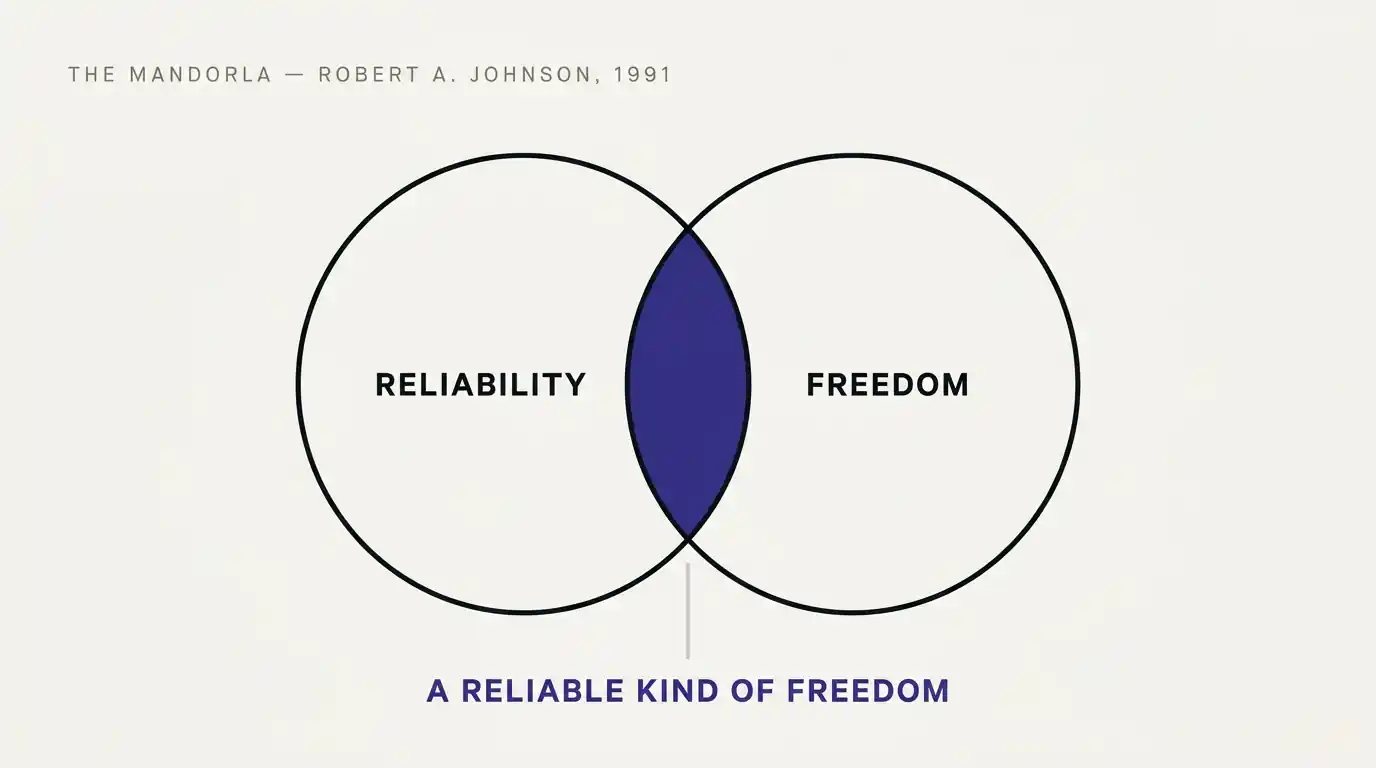
- The mandorla. When two circles overlap, the overlap forms an almond shape. Johnson used this shape, the mandorla, as an image for holding two opposites at once without collapsing into either, until a third option appears that respects both.
An earlier book of his, Inner Work (1986), set out a four-step method for working with dreams: your personal associations to each image, the connection of each image to something active in your life, an interpretation that puts the two together, and a small ritual that makes the meaning concrete.
Where the phrase "shadow work" came from
Jung wrote about the shadow, not about "shadow work." The phrase came later, from therapists and writers who built practices on his ideas. Meeting the Shadow (1991), an anthology edited by Connie Zweig and Jeremiah Abrams, collected many of those writers in one book. Zweig and Steve Wolf's Romancing the Shadow (1997) presented shadow-work as a named practice.
Then, in 2023, a self-published workbook called The Shadow Work Journal spread across TikTok, and the term reached millions of people who had never read Jung. That did something useful: it put the idea in front of people who would never have found it otherwise. It also changed the idea. In much of the trend, shadow work means writing answers to a fixed list of prompts about childhood wounds, as a form of self-treatment. Clinicians have pointed out that this is not quite what Jung meant, and that some people should not do it alone.
Both points are fair, and both come up again below.
How the shadow shows up
You can't look at the shadow directly, so you watch for the places where it leaks. Five are common.
A reaction bigger than its cause. A colleague's reply-all irritates you for two days. Your partner forgets one small thing and you are furious for the evening. The size of the reaction is the evidence. Whatever you are reacting to is real, but the extra part belongs to something else.
Projection, in both directions. The first direction is familiar: a type of person you can't stand, often someone who does openly what you never allow yourself to do. The second direction is quieter, and it is where Johnson found the gold. It sounds like admiration with a limit attached: "I could never be that bold." "I'm not a creative person, but she is." The limit is the clue.
A value you keep "failing." You value reliability, and you keep cancelling at the last minute. You value calm, and you keep snapping at people. The usual reading is that you are falling short. The shadow reading asks what the behavior is trying to say.
A want you apologize for. "Part of me wants to disappear for a month. Sorry, that sounds terrible." The apology tells you the want was ruled out somewhere, by someone.
A dream that keeps coming back. Jung and Johnson both gave recurring dreams close attention. What keeps returning is usually asking for something.
None of these proves anything on its own. They are places to look.
Is shadow work dangerous?
People usually mean one of two things by this question, and they need different answers.
The fear of what you will find
The name suggests a basement full of monsters. What most people actually find there is ordinary: anger they were never allowed to show, a wish to be noticed, a need for rest, ambition they were told was selfish, tenderness they were told was weak. Johnson's observation was that the gold frightens people more than the dark material does, because owning it means you might have to act like the person who has it.
It also helps to separate a want from an act. Wanting to quit is not quitting. Imagining shouting at someone is not shouting. A thought you are ashamed of does not make you worse, and looking at it does not commit you to anything.
The material you don't look at is the material that acts. It shows up as sarcasm, as overreactions, as the same argument repeated with different people. Looking at it is what gives you a choice about it. In Johnson's terms, the shadow gets paid either way. The only question is whether you choose how.
The caution that is real
The clinicians' warning is aimed at something real: workbooks that send people, alone, into memories of harm.
Harm done to you is not your shadow. Abuse, violence, betrayal and neglect are things that happened to you. They are not qualities you disowned, and looking for the hidden gift in them is the wrong move. Working through that kind of history is the work of a trained professional, and nothing in this article is a substitute for it.
Jung's and Johnson's shadow is about what you pushed away, not about what was done to you. The line between them can be close. Anger you were never allowed to feel about something that happened is your own material, when you choose to bring it. The harm itself is not.
There is a second, simpler caution. If looking at something floods you instead of opening it, so that you can't think, the feeling keeps rising, or you go blank, stop going deeper. It will still be there when you can hold it.
What "gold in the shadow" means in practice
The phrase sounds abstract until you follow one feeling all the way through. Here is how that can go.
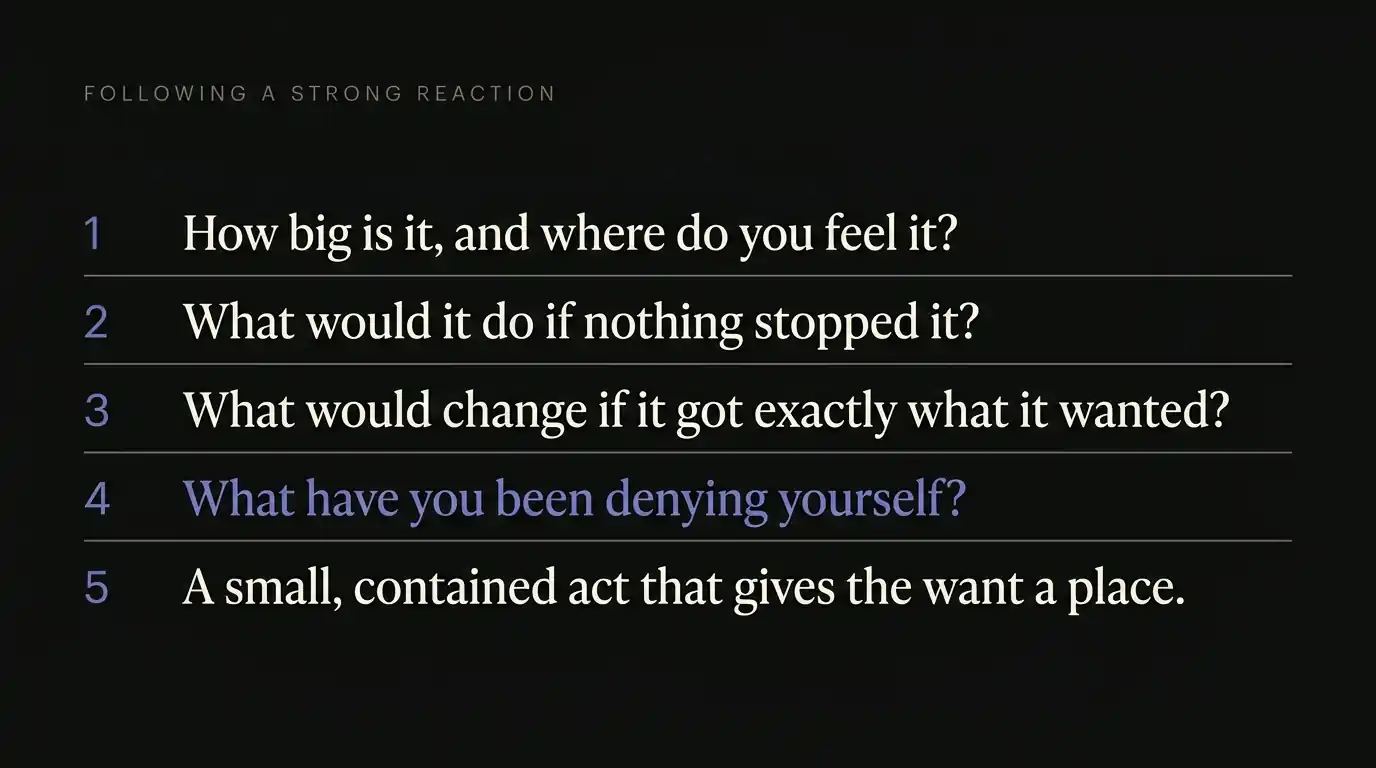
Following a strong reaction to what it wants
Your sister asks, for the third time this month, whether you can pick up her kids. You say yes, as you always do, and spend the evening furious, mostly at yourself.
Don't calm the anger down or talk yourself out of it. Ask how big it is, and where you feel it. Then ask what it would do if nothing stopped it. Say the answer is: cancel everything for a week and stop answering the phone.
Now ask what it wants: what would change if it got exactly what it wanted? This is usually the turning point, because the answer is rarely destruction. Here it might be: evenings that belong to you, and permission to say no without a long explanation.
That is the gold. The anger was guarding something you had been denying yourself: time of your own, and the self-respect of a plain no. Your reliability, which you are proud of, had pushed it out of the picture.
The last step is Johnson's payment, and it is small and contained on purpose. Maybe one evening a week is simply not available, and you don't explain it. It is never aimed at your sister as a punishment. It gives the want a place, so the want no longer has to arrive as rage.
Reclaiming a quality you admire
There is a colleague who says "I don't think that works" in meetings and doesn't soften it. You admire her, and you have decided you could never be like that.
Look at the act, not the adjective. "She's confident" is an adjective. Saying "I don't think that works" without softening it is the act. Then ask when you last did a small version of it, and what happened next. Ask what having that quality would cost you, and who would object. Then ask whether any piece of it is yours to take.
People who do this often find that they once had the quality, used it, and were punished for it. The quality didn't go away. It went into the shadow.
Holding two things at once
Sometimes there is no winner. You value reliability. Something in you wants freedom. Most advice would tell you which one to drop.
Johnson's mandorla asks a different question: what would a reliable kind of freedom look like? Freedom you can be counted on to take, at a set time, in a set form. The value and the pull both stay. Neither has to lose.
Why journal prompts and generic AI tend to miss it
A prompt list is the same for everyone. Shadow material is not. It is in the word that carried the most heat in what you said, in the part of the story you spent three paragraphs on when the event took one sentence. A fixed list of questions can't follow that, because it never heard you.
Anyone who interprets shadow material for someone else, human or machine, can fail in three ways.
The first is playing oracle: telling you what your shadow is, what your dream means, or who your anger is "really" about. A discovery you are handed changes much less than one you make.
The second is planting. "Isn't this really about your mother?" sounds like a question, but it carries an answer, and a person in the middle of a strong feeling tends to take a planted answer as their own.
The third is the worst: treating your rejection as proof. "The strength of your no says something." Nothing you could say would disprove that claim, so it can't be tested, and that makes it a manipulation pattern, however gently it is delivered.
A general-purpose AI agent adds a problem of its own. It tends to agree with you, for reasons covered in why AI agrees with everything you say. An agreeable machine either confirms whatever reading you bring, or produces a confident reading for the average person, who is not you. And if what you are really looking for is treatment, a chatbot is the wrong tool for that too.
The Shadow in Daiven
Daiven has ten agents, each with one job. The Shadow is the one built on Jung and Johnson.
Every session starts with Daiven's intake. If what you want is to understand a feeling bigger than its cause, a quality you keep admiring in other people, or a dream that keeps coming back, intake routes you to The Shadow.
How it works
The Shadow follows the feeling, not the story. When your explanation moves away from the feeling, it brings you back: where the feeling sits, what it would do, what it wants.
It asks questions that open a direction and leave the content to you. "When did you last do something completely useless?" points somewhere. "Are you jealous of her freedom?" already contains the answer, so it doesn't ask that one.
Each question comes with something it noticed in what you said, so the conversation never turns into an interrogation. That might be the word with the most heat, or two things you said placed side by side: "you never argue with him, and you remember every word he said in that meeting."
When you ask it something directly, such as what projection is, what an image commonly means, or what it thinks is going on, it answers plainly, says what the answer rests on, and connects it back to your material. When you have circled the same point without anything new, it offers the reading it has been holding, with its basis, for you to test.
It reads your profile in reverse. A record full of duty and empty of play is a reason to ask about play. It uses what it notices to choose its questions, and if you ask why it asked something, it tells you what it noticed and that it was a guess.
For dreams it follows Johnson's order: your associations first, then the figure least like you, then what keeps coming back and what was happening in your life when it started. When you have named a part of yourself, such as "the one who wants to quit," you can talk with it. The Shadow puts the questions to the part. You answer for it, because The Shadow never speaks as a part of you.
What it won't do
- A no ends the direction. If you reject a reading, it drops it for the rest of the conversation. It never treats the force of your no as evidence.
- It doesn't look for gold in harm done to you. It stays with what you told it, and says plainly when a professional is the right person for that work.
- Imagery stays imagery. Your anger can imagine anything, and The Shadow will ask about it. It will not help you plan, draft or rehearse an act against a real person.
- It doesn't approve or forbid. Finding what a want is pointing at is not permission to act it out. What you do with it is your decision.
- It doesn't diagnose. It explains the ideas it works from when that helps, and never uses them to label you.
What gets written down
Only what you claim, and only with your confirmation. A need you name as one you can't do without is recorded as a need. A quality you claim as yours becomes one of your core values, and the change is logged in your value history. A pattern of reactions you recognize as yours is recorded as a pattern. Guesses The Shadow held and readings you turned down are never written.
Over time, that value history becomes a record of what crossed over: the things that started in the shadow and became part of how you see yourself.
The Shadow opens. When the next question is how this fits who you are and how you live, that belongs to The Mirror, which The Shadow will suggest at the end.
None of this is therapy, and The Shadow does not claim to know your shadow. It knows a direction to look in, and it leaves the finding to you.
The shadow gets paid either way. Shadow work is choosing how.
See what each of Daiven's agents does, including The Shadow and The Mirror.
Questions people ask

Written by
Przemek Czerpiński
Founder & Developer
Przemek Czerpiński founded Daiven and built it himself. He's been building LLM products since 2024 — most recently multi-agent systems designed to adapt to people without flattering them. He studies AI behavior directly, testing it extensively in the roles people hand it: assistant, therapist, companion, advisor. Before that he spent over a decade in consumer products, where engagement was the metric. That's what Daiven is built against. More about him and about Daiven.
Now check it against your own decisions.
Daiven measures what you do against the values, principles, and goals you've already written down — not the tone of your last message.
Start free trial